

We all love sugar, especially when it's in the form of a caramel or a butterscotch-type "quick caramel" sauce. Caramel drizzled over cakes is the best, and ice cream too, or baked apples. You can even layer caramel into cakes. Unfortunately, sugar can be a real pain to work with.
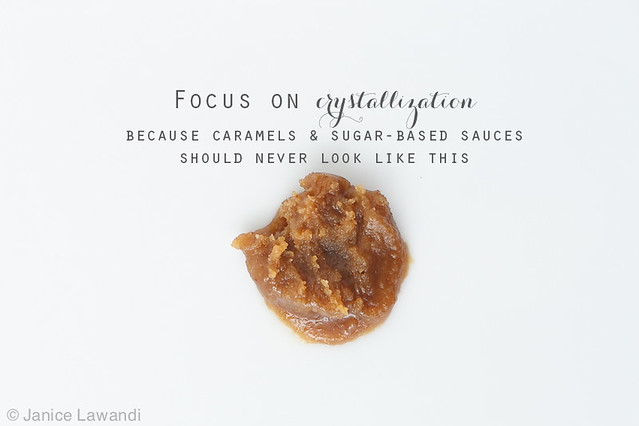
In the kitchen, I think the number one problem with working with sugar is that it crystallizes, especially when you don't want it to, like when you are making quick caramel sauces, buttery salted caramel sauce, or soft and chewy sea salt caramels. Fortunately, there are tricks that you can do so that your caramels and sauces don't turn gritty.
What is sugar?
Granulated sugar is sucrose
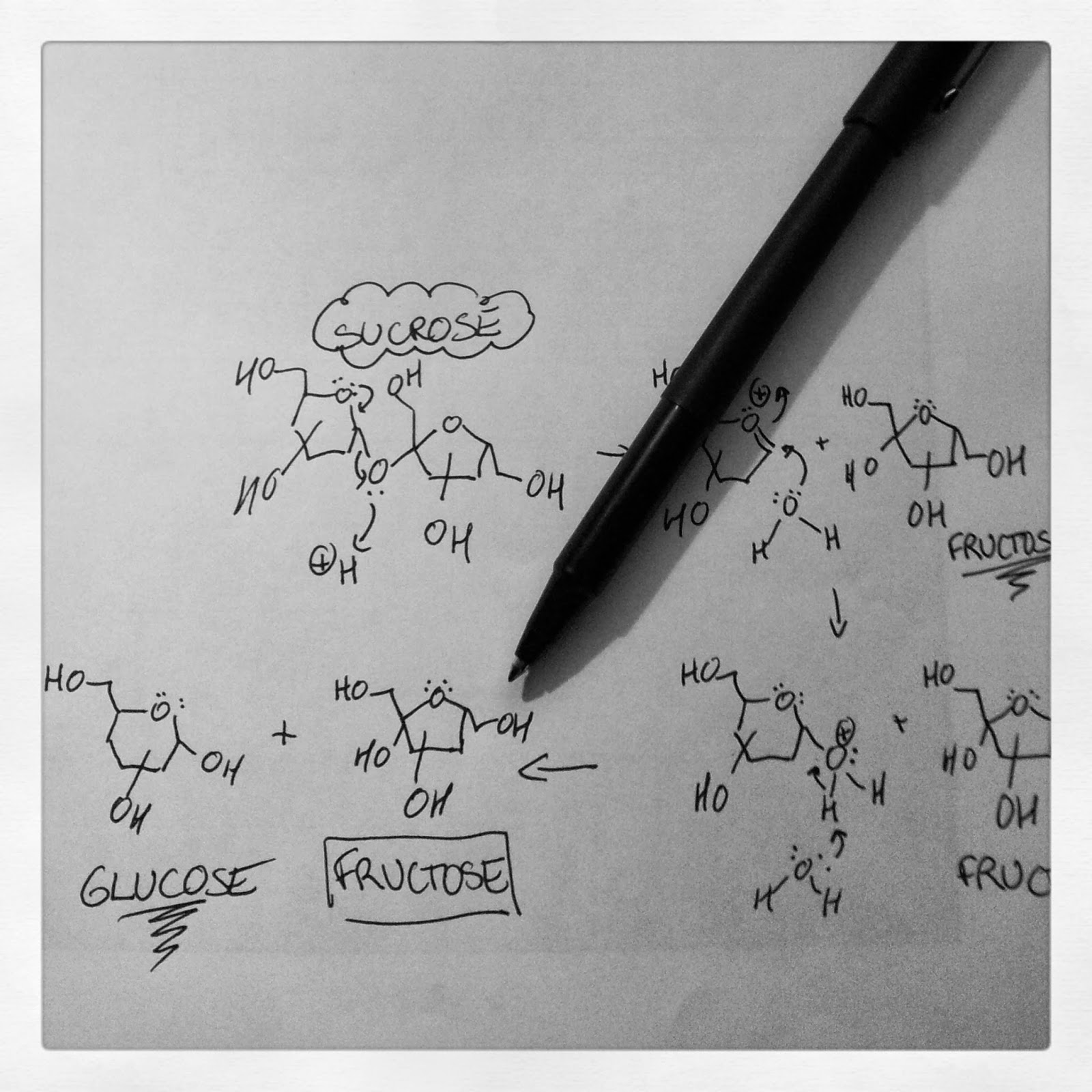
In baking, the most common form of sugar we use in the kitchen is granulated sugar. People often assume that granulated sugar is glucose, but it's not. Glucose, along with fructose, are actually the building blocks that make up each molecule of sucrose that is granulated sugar. Brown sugar, like white sugar, is also mostly sucrose. It's important to note that in sucrose, glucose and fructose are chemically bonded.
Invert sugars such as honey, corn syrup, and glucose
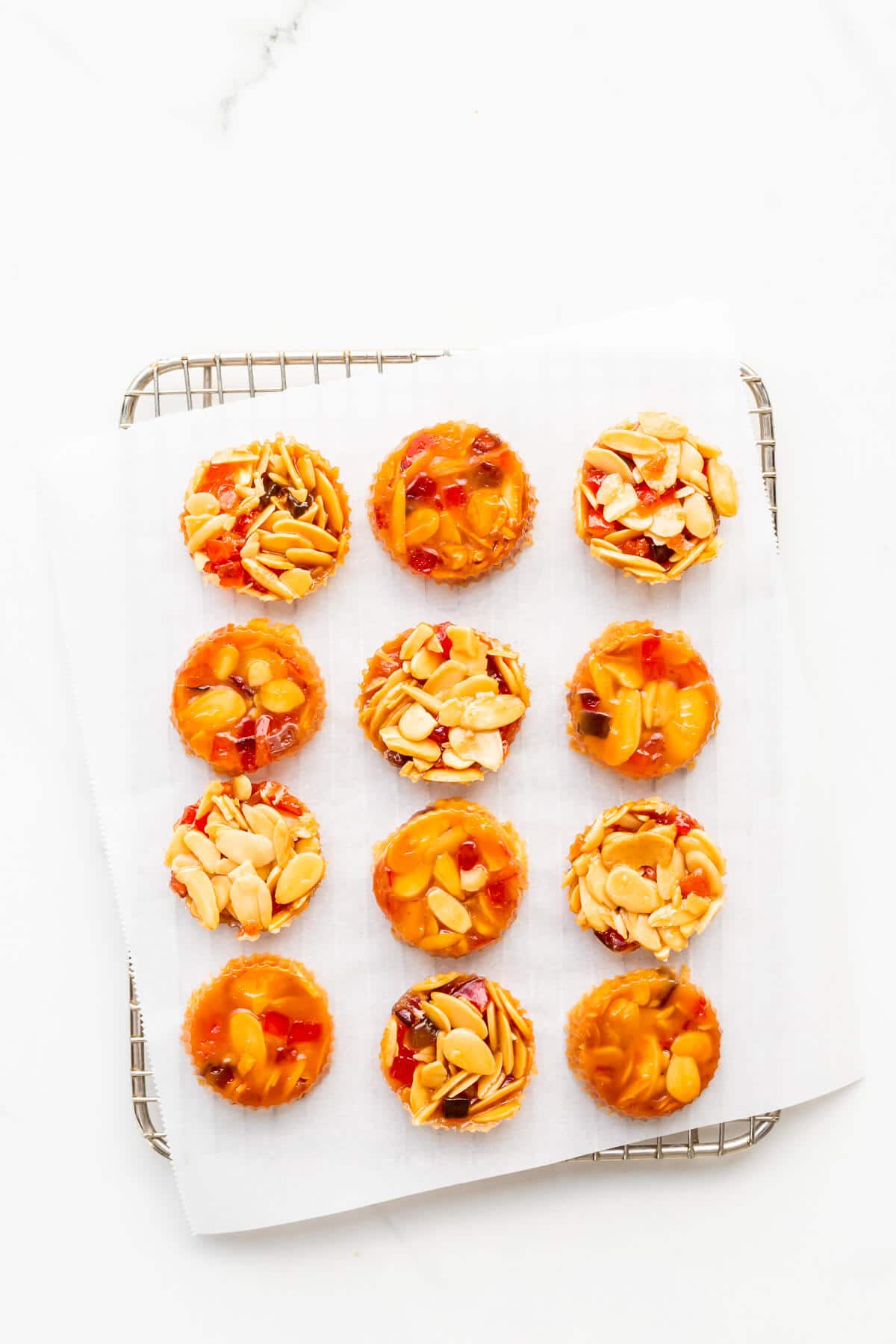
The other type of sugar you need to be aware of is "invert sugar", such as corn syrup. Invert sugars are made when larger sugars, like sucrose, are broken down to their basic building blocks, glucose and fructose. What most people don't realize is that corn syrup actually comes from corn starch. Starch is the storage form of glucose in plants, and it's a long chain of glucose molecules bonded together. If you treat starch with either an enzyme (amylase) or an acid and a little heat, the starch chains break down into their building blocks: you obtain lots of glucose. Corn syrup that is readily available at grocery stores is a glucose syrup. Some corn syrups contain maltose (coming from the break-down of glucose-containing amylose starches). Honey is also an invert sugar: bees drink flower nectar containing sucrose, and they secrete an enzyme (invertase) that breaks down the sucrose (digestive acids also help this process) to form glucose and fructose. In honey, glucose and fructose are present in equal parts. You'll notice honey in these florentine cookies. Not only does it add flavour, it also ensures the sugar doesn't crystallize, leading to a gritty texture!
Corn syrup vs high-fructose corn syrup (HFCS)
Corn syrups we use at home are not to be confused with high-fructose corn syrup, which are made by treating regular corn syrup with an isomerase that converts glucose to fructose. The corn syrup you buy in grocery stores is not high fructose corn syrup.
Why do we need to know about granulated sugar and sucrose?
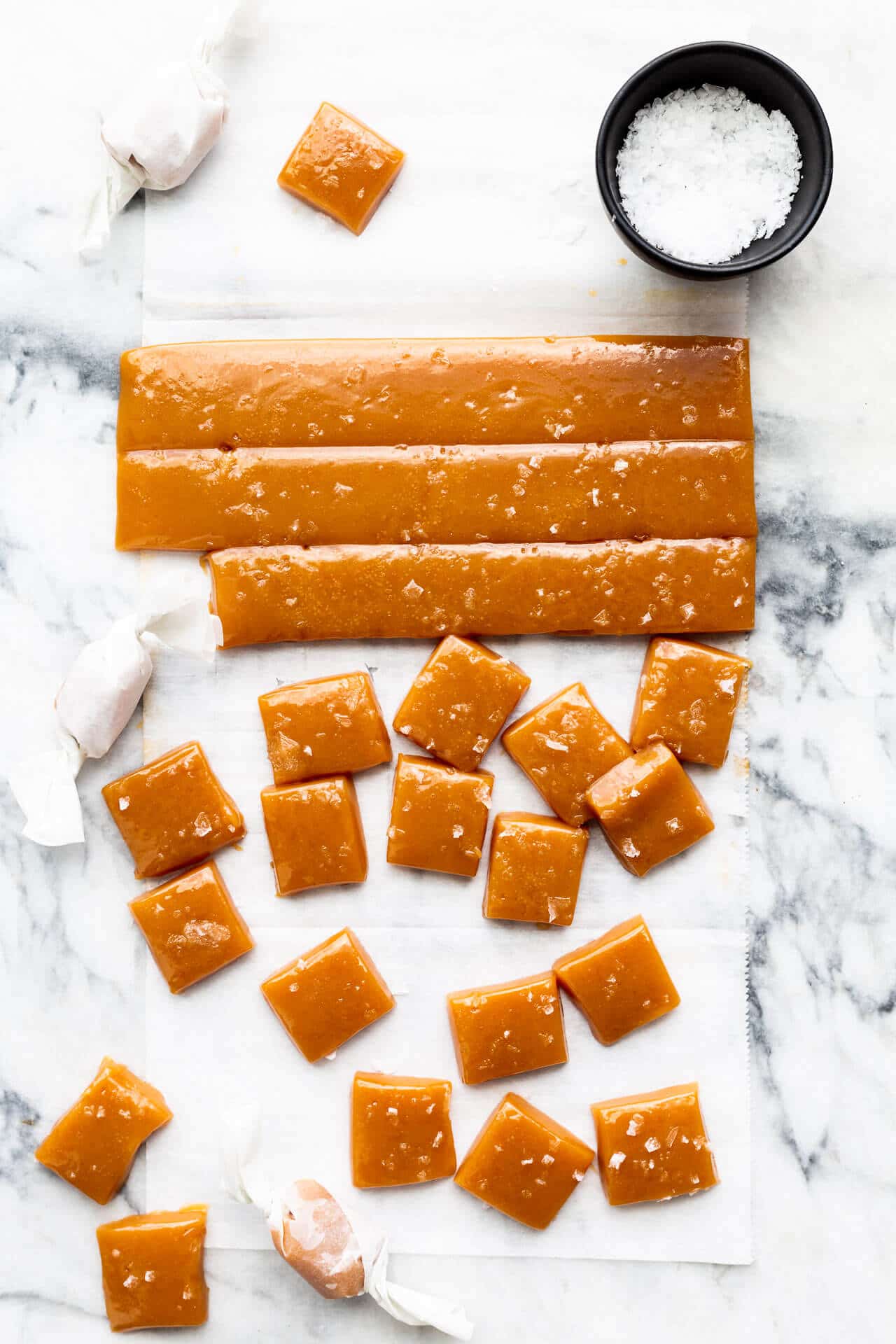
When sucrose is present in high concentrations, like when you are making butterscotch that's loaded with brown sugar, the sucrose molecules tend to pile up and crystallize. The molecules just can't help but crystallize because there is so much sucrose around. The caramels and quick caramels can become powdery, or even gritty (if larger crystals form) because the sucrose is essentially precipitating/crystallizing out of the sauce.
How do you stop caramel from crystallizing?
There are 2 important methods to ensure your caramel sauce doesn't crystallize when you don't want it to:
- Add an invert sugar like corn syrup or honey: The most common precaution to prevent crystallization in recipes for caramel sauces is to add an invert sugar to your recipe, like corn syrup or honey. Why? Remember invert sugars contain glucose and fructose. Sucrose has a harder time crystallizing when glucose and fructose are floating around in the saucepan because glucose and fructose prevent the sucrose molecules from piling up on each other and crystallizing. Invert sugars interfere with the crystallization of sucrose, and therefore sugar sauces and caramels are less likely to crystallize if you add a little bit of corn syrup or honey to your recipe. This is one instance when you cannot use maple syrup! Though maple syrup is often a good substitute for honey in baking, maple syrup is mostly sucrose, and therefore does not qualify as an invert sugar, nor will it help you prevent caramel sauces from crystallizing. Stick with corn syrup or honey. Glucose syrup is also a great option (you can buy it on Amazon or at specialty baking stores).
- Add an acid: If you are out of corn syrup and don't have honey on hand, you have a second option: add a squeeze of lemon juice. Lemon juice is acidic and therefore if you mix a little lemon juice with sucrose, and you heat the mixture, some of the sucrose will break down to its building blocks, i.e. glucose and fructose. By adding a little lemon juice to your sugar sauces and caramels, you are basically making a little invert sugar in your saucepan so that the sucrose, and your caramel, won't crystallize.
There are also 2 additional points to consider to avoid crystallization of caramel sauces:
- Make sure the sugar is dissolved properly before you increase the heat: when making salted caramels and caramel sauce recipes that involve caramelizing granulated sugar before adding cream and butter, I find it's very important to add a little water to your saucepan to help dissolve all the sugar crystals on low heat before heating the mixture at a higher temperature to caramelize the sugars. I find starting with water helps prevent a lot of problems later on.
- Change the order of ingredients: for caramel sauce recipes, I make sure to put the liquid in the saucepan first. Then I add the sugar on top of the liquid. I find by respecting this order, the sugar dissolves more easily and more evenly at low heat, with minimal stirring.
Methods to prevent caramel crystallization
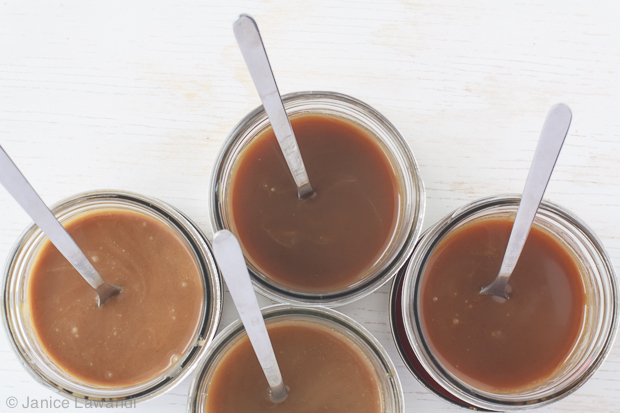
I hope I have helped clarify the theory behind why some batches of caramel crystallize. Adding a little corn syrup to a batch of caramel makes sense on paper, but it's always nice to test out the options ourselves, so that's what I did.
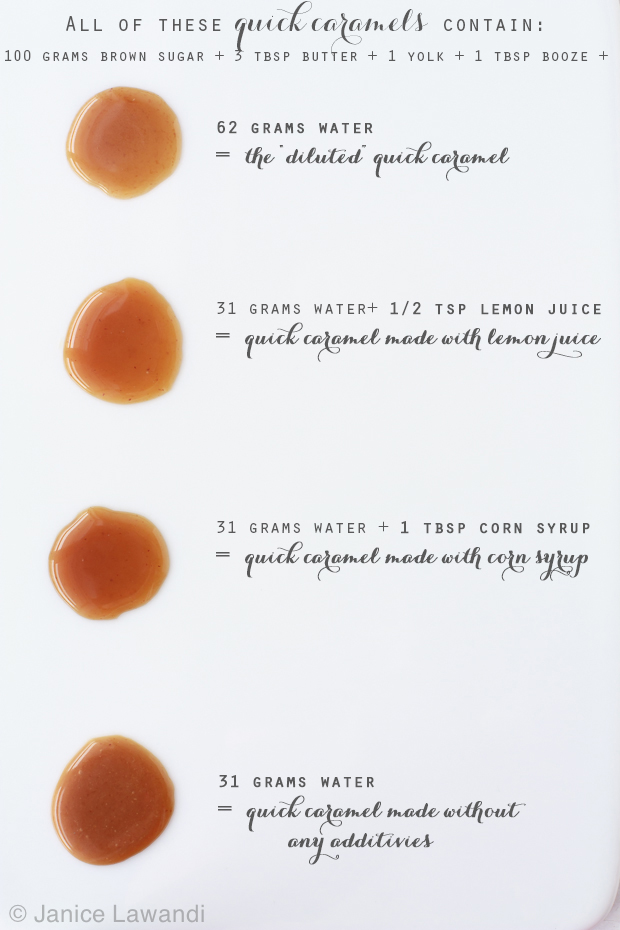
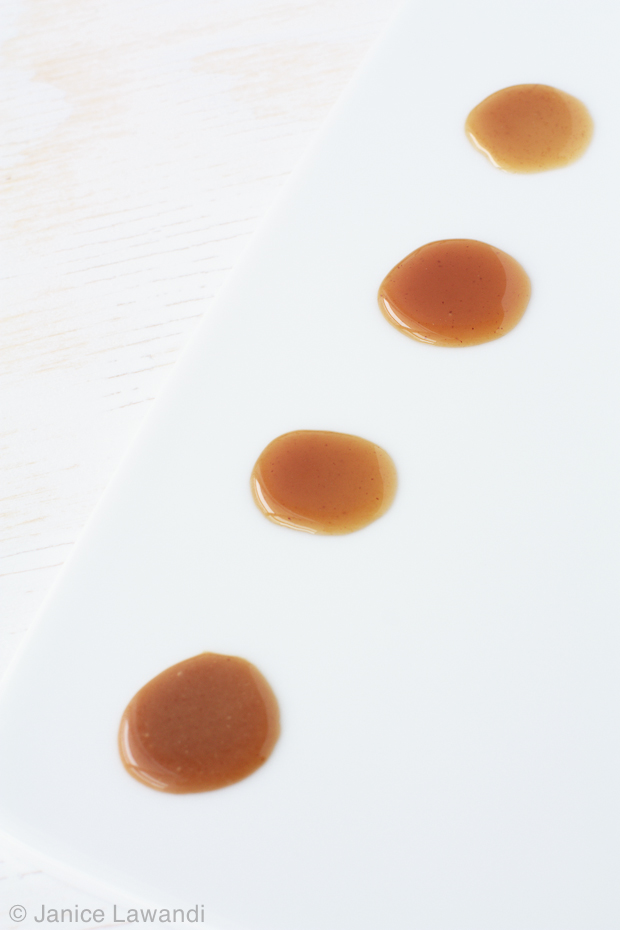
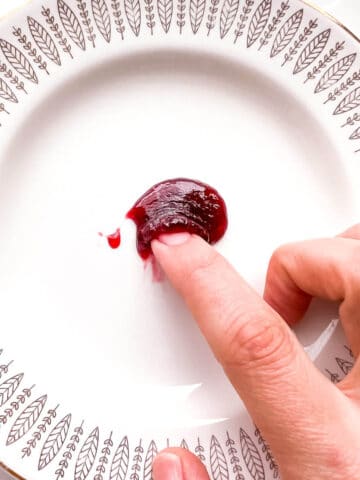
It's hard to tell from the photos but the quick caramel prepared with no additives and a small amount of water is more opaque and less clear than all the others: this sauce has a powdery mouthfeel, reminiscent of brown sugar fudge. On the other hand, the caramel sauces made with either corn syrup or lemon juice are much clearer. The mouthfeel of both sauces is completely smooth, without any detectable powdery texture. Of course, the flavour of the sauce containing lemon juice was a little more citrusy, which personally I wasn't a fan of. So, lemon juice works to prevent sugar sauces from crystallizing, but perhaps the flavour might not be what you are looking for.
I tested out one more option that's not "in the books": dilution. From a practical standpoint, caramel sauces tend to crystallize because there's so much sucrose dissolved in so little water, so I doubled the amount of water to see what would happen if I made a more dilute quick caramel. Obviously the "diluted" quick caramel was a little waterier, especially next to the other batches, but from a crystallization standpoint, this sauce didn't become powdery or gritty. Of course, this option won't be of much help if you are making a real caramel because most of the water evaporates as the sugar boils, but for a quick caramel sauce, it's definitely another option worth considering. In fact, my grandmother's quick caramel sauce recipe contains double the water than the one I served with the baked apples.
Crystallization is a science
I find it ironic because as a chemist, I spent a lot of time trying to force my products to crystallize, and yet in the kitchen, we usually strive for the opposite in a perfectly smooth caramel sauce. Luckily, we have a few tricks to choose from so that we never have to face a batch of caramel turned to a solid mass of gritty sugar.
In some recipes, crystallization is a good thing!
When you are following a maple fudge recipe or making a batch of homemade maple butter, you actually want sugar crystallization to occur. These recipes use temperature to control crystallization and to make sure you form fine sugar crystals. The size of the sugar crystals can't be too large or you will end up with gritty fudge or hard maple candy.
joe weinskovich says
Excellent info Janice,
My question is how to make a caramel sauce that can be easily dissolved in an iced coffee. The coffee will be very cold when we mix the caramel sauce in it. We do food festivals and we have to work very fast to keep our lines moving quickly.
Thank you so much, I'm very glad I found your site.
Joe
Mary says
hi Joe,
Did you find an answer to this? I have the same question.
Mary
Suzie says
Hello,
A quick question around making large batches of sugar syrup....
I've been making the stuff for years with no problem of crystallization. I add water, sugar and some lemon juice which works perfectly everytime.
I've just moved and tried to make more using my tried & tested technique, but TWICE I've had it crystallize on me!
Is there anything that could be causing this? Is my new hob heating it too fast? is the water too hard?
ANY advice would be much appreciated!
Janice says
Hi Suzie, I'm sorry you're suddenly running into crystallization problems while making syrup! The only thing that comes to mind: are you sure the sugar is properly dissolved before you bring the syrup to a boil? Perhaps your new stove is very powerful and maybe starting the syrup on a lower setting will help you dissolve all the sugar crystals before cranking up the heat to boil the syrup. Like you said: maybe the mixture is heating up too fast and there's undissolved sugar crystals that float around and initiate the crystallization process.
Danah says
Dear Janice
I'm recently into making Sticky buns, I tried several recipes, the cooked sugar bottom (later topping) is amazing when it's hot and right out the oven.. however soon after serving it turns hard and sticks to teeth . I don't want that..
Basically it's made of butter, brown sugar, honey/corn syrup
What do u suggest ? Please help
Thank you
Joyce says
Thanks for the informative article! I've made chewy caramel candies at home, but noticed that they tend to turn grainy after a few weeks. What's happening to cause that? Is it storage or how the candy was made?
Jeffrey Frese says
Any idea how to make it so xylitol and erythritol not crystalize? I'm trying to make a sugar free marshmallow fluff and it's very crunchy.
Blair says
Thank you for the lovely article! What about sugar crystallization in icings? I have a cream cheese icing that tends to bloom after a few days in the freezer.
Steve Kippels says
Hi,
I am a commercial toffee maker who has searched for years to find a knowledgeable sugar alchemist who might be able to answer some of my pesky questions abour cooked sugar, Maillard browning and the other "black magic" that seems to be involved in successful toffee production.
Would you be open to share your expertise in exchange for the toffee fruits of my labor?
It would be greatly appreciated!
Best Regards,
Steve
Craftmade Toffee
Chuck Birch says
OK,
Now that I have made a few batches of Maple Butter and got the hang of it, what can I do with the batches that crystalized and got grainy?
Kimberley says
Hi,
Now that Kayro syrup does not have Fructose in it, will it still prevent crystallization? How much Kayro would I substitute for 1 cup of sugar to eliminate the crystals? Would you add water as well as substituting sugar with the Kayro?
Janice says
Hi Kimberley, I would follow the chart above for the corn syrup. No need to make any changes as far as I know!
Timothy Fitzgerald Young says
Great information.
I'm a small specialty food creator in Michigan and I'm developing some caramel sauce and would like to avoid corn syrup due to consumer apprehension over GMO's and more. Honey tends to be pretty expensive, so I'm wondering if you think Agave would work? And could you use less if you combined with a little citric acid?
Janice says
Hi Timothy! Can you get glucose syrup? Pastry chefs often use it in caramels to prevent crystallization. Otherwise honey or agave could work because they do contain a fair amount of invert sugars (glucose and fructose), though I've honestly never tried them. I'd worry about the citric acid and the flavour it might impart: a little goes a long way in adding tang to foods! I hope that helps, and thanks for reading!
Liz says
Another educational blog for me! I tend not to make sauces as they add calories!!