

Learn how to make the best lemon curd from scratch with this easy recipe. This recipe for lemon curd makes about 2 cups, from freshly squeezed lemon juice, egg yolks, sugar, and butter, without any thickeners or gelatin.
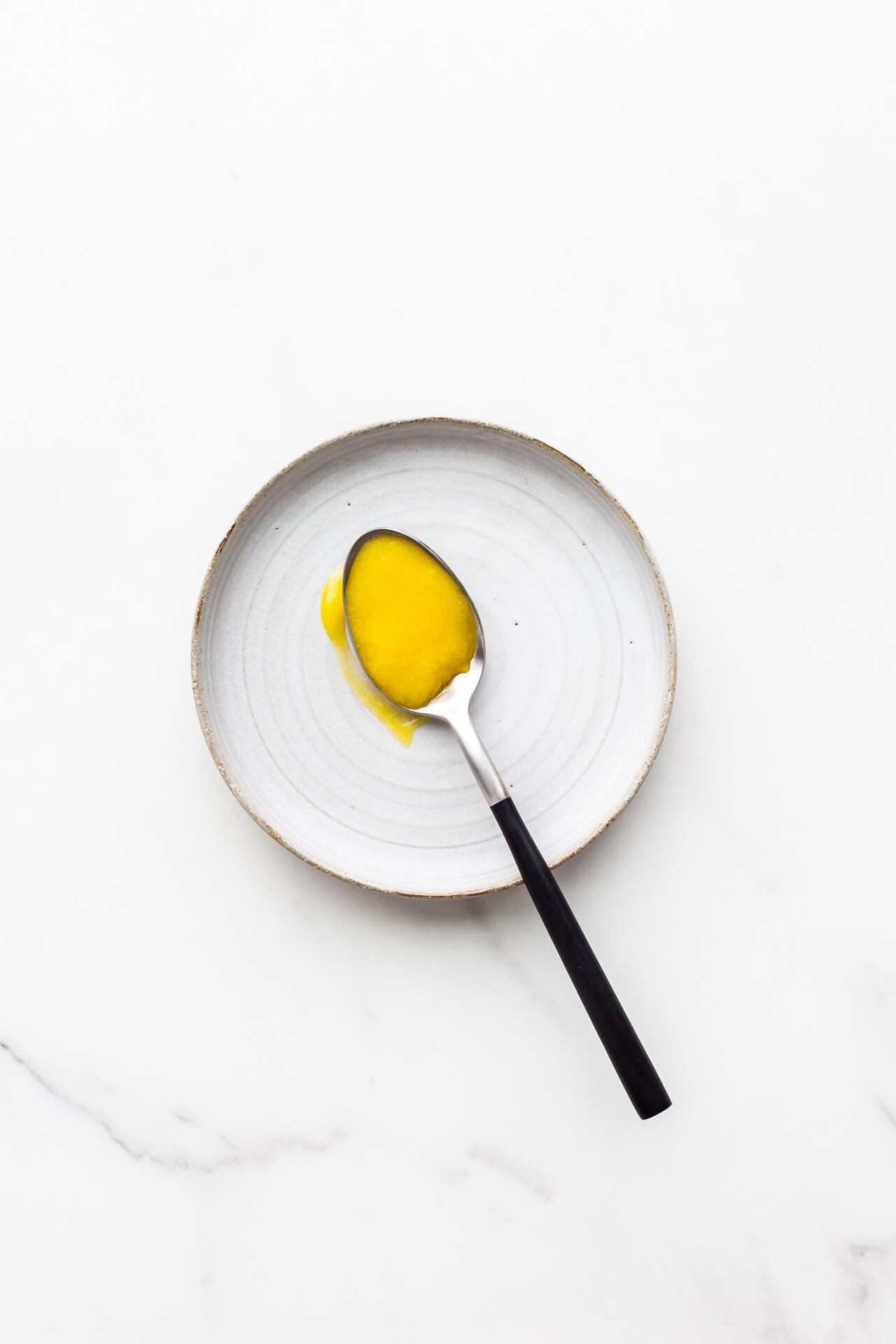
Learning to make lemon curd is life-changing! Once you start making lemon curd from scratch at home, you will become a lemon curd snob and you will come to hate the store-bought stuff, which pales in comparison.
Jump to:
Ingredients
Lemon curd is made from a simple list of ingredients, specifically:
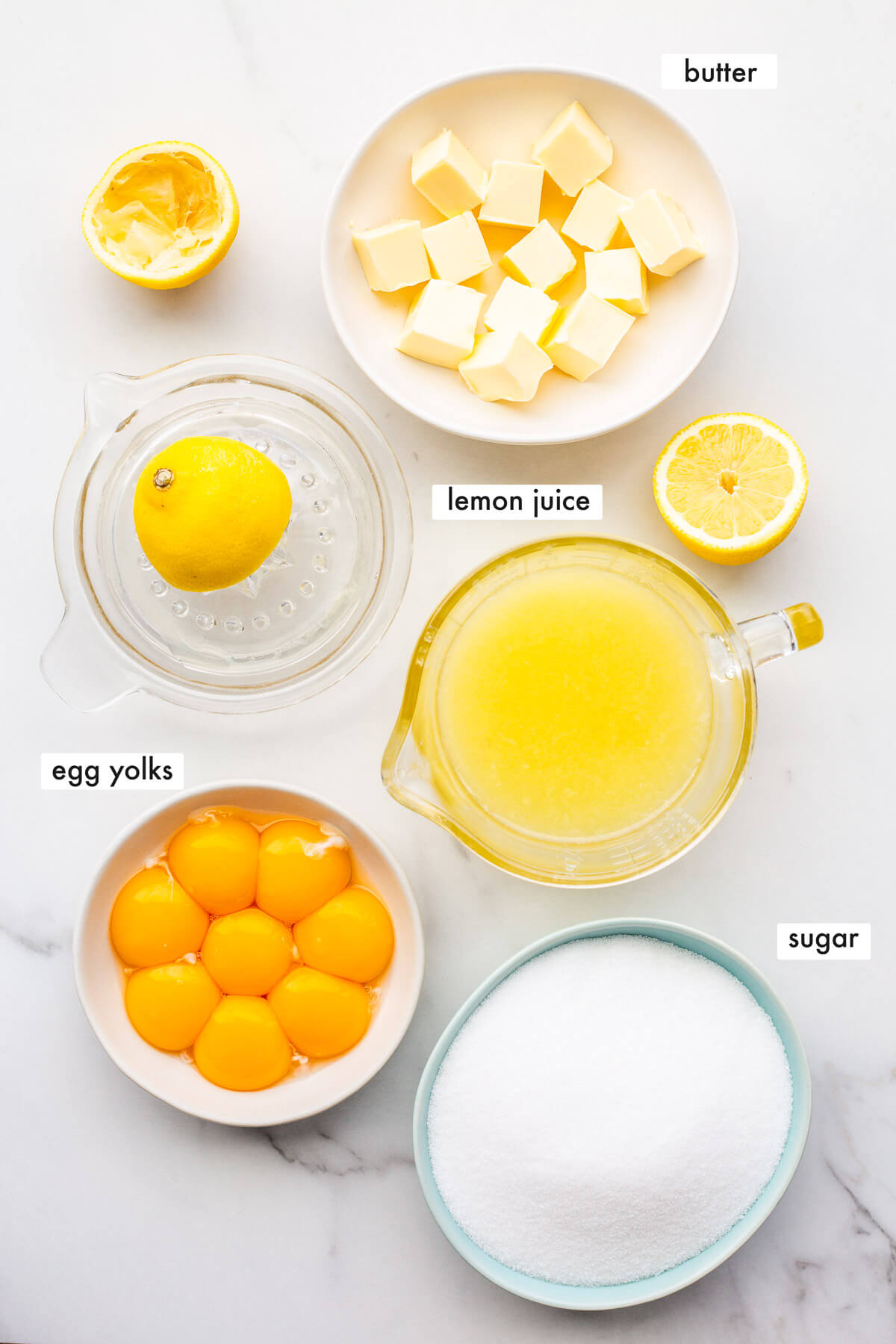
- fresh lemons—the flavour of lemon curd is superior if you use freshly squeezed lemon juice and lemon zest. Store-bought lemon juice sold in bottles is not a good baking substitution for lemon juice in this recipe.
- egg yolks or whole eggs—these help thicken the curd and provide body. The yolks contribute to the bright yellow colour, making it look less creamy
- sugar—use granulated sugar because the goal is to sweeten and enhance the lemon flavour without masking the acidity or interfering with it. Other sugars may overpower the lemon flavour.
- butter—I use unsalted butter here but a little salt in this recipe can enhance the flavours, but too much will interfere. If you want to experiment with salted butter, I recommend starting with a semi-salt butter to avoid adding too much salt to the curd.
Please see the recipe card for the exact ingredients and quantities.
Additional Ingredients (Optional)
Other ingredients that you may see in lemon curd recipes help to make the curd thicker and more stable. These ingredients include:
- Gelatin or agar agar helps to trap water, thickening the curd and stabilizing it. For example, for the blackberry curd, I added gelatin because the curd is a filling for a layer cake and needs to be stable enough to hold the weight of the layers.
- Starches or flour also helps thicken the curd, like in pastry cream. I tend to avoid these because I find starches and flour dull the flavour of lemon curd.
Important Note About Tools and Equipment
The pH of lemon juice is low, between 2 and 3. This means that you have to be careful with the cookware and bakeware you use when cooking lemon curd and baking lemon bars or anything else that contains a lot of lemon. Make sure to use high quality stainless steel tools. For example I use my OXO whisk to make lemon curd. I once used a dollar store whisk and the flavour was metallic and inedible.
Avoid uncoated aluminum bakeware (sometimes called "natural aluminum") and copper pots which are reactive. Favour anodized aluminum or aluminized steel bakeware, or bakeware with a coating on it.
How to Make Lemon Curd on the Stove
There are a few ways to mix the ingredients to make lemon curd and a few ways to cook them to achieve the perfect set. It's all dependent on comfort and skill levels. I prefer to make curd stepwise directly on the stove, as opposed to one-bowl methods in the microwave or over a double boiler.
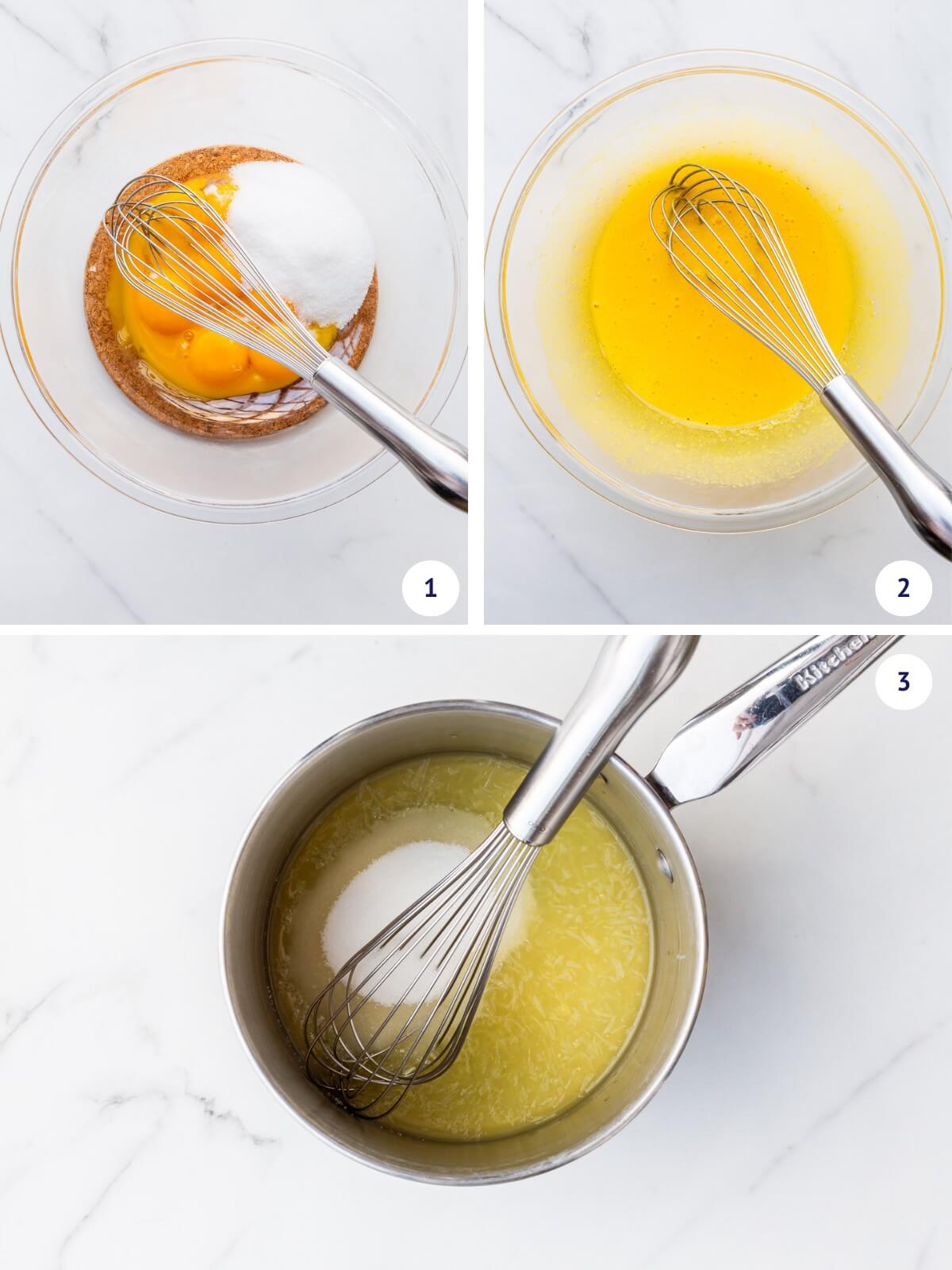
Step 1—whisk the egg yolks with part of the sugar in a medium bowl (image 1) until they have lightened in colour (image 2), Meanwhile combine the lemon juice and the rest of the sugar (image 3) and bring it almost to a boil directly on the stove.
Vocabulary: "Blanchir les oeuf," is the French pastry term for whisking the eggs with the sugar until they are lightened in colour (instead of orange-yellow hue). You do this step to avoid leaving the eggs to sit with the sugar, which can cause the proteins to coagulate, like the eggs are hard cooked.
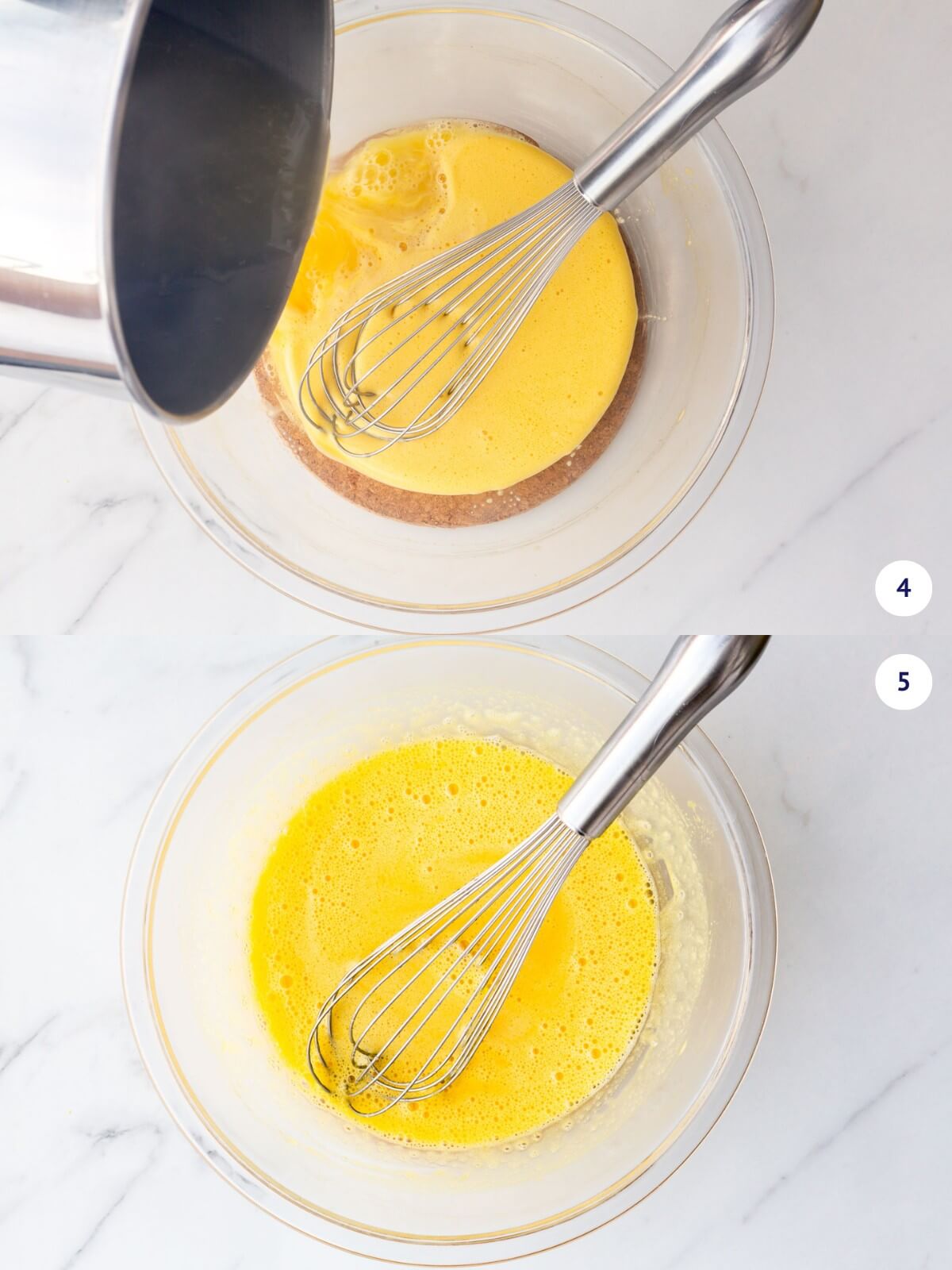
Step 2—Pour the hot lemon juice over the whisked egg mixture to temper the eggs (image 4). Whisk the mixture until it's homogenous and has a thin foam on the top (image 5).
Vocabulary: Once the eggs and sugar have been whipped and the sweet lemon mixture on the stove is hot, the hot liquid is poured over the eggs, while whisking. The baking term for this step is "tempering the eggs". The goal is to gently raise the temperature of the eggs so that they are warm without shocking them on the stove.
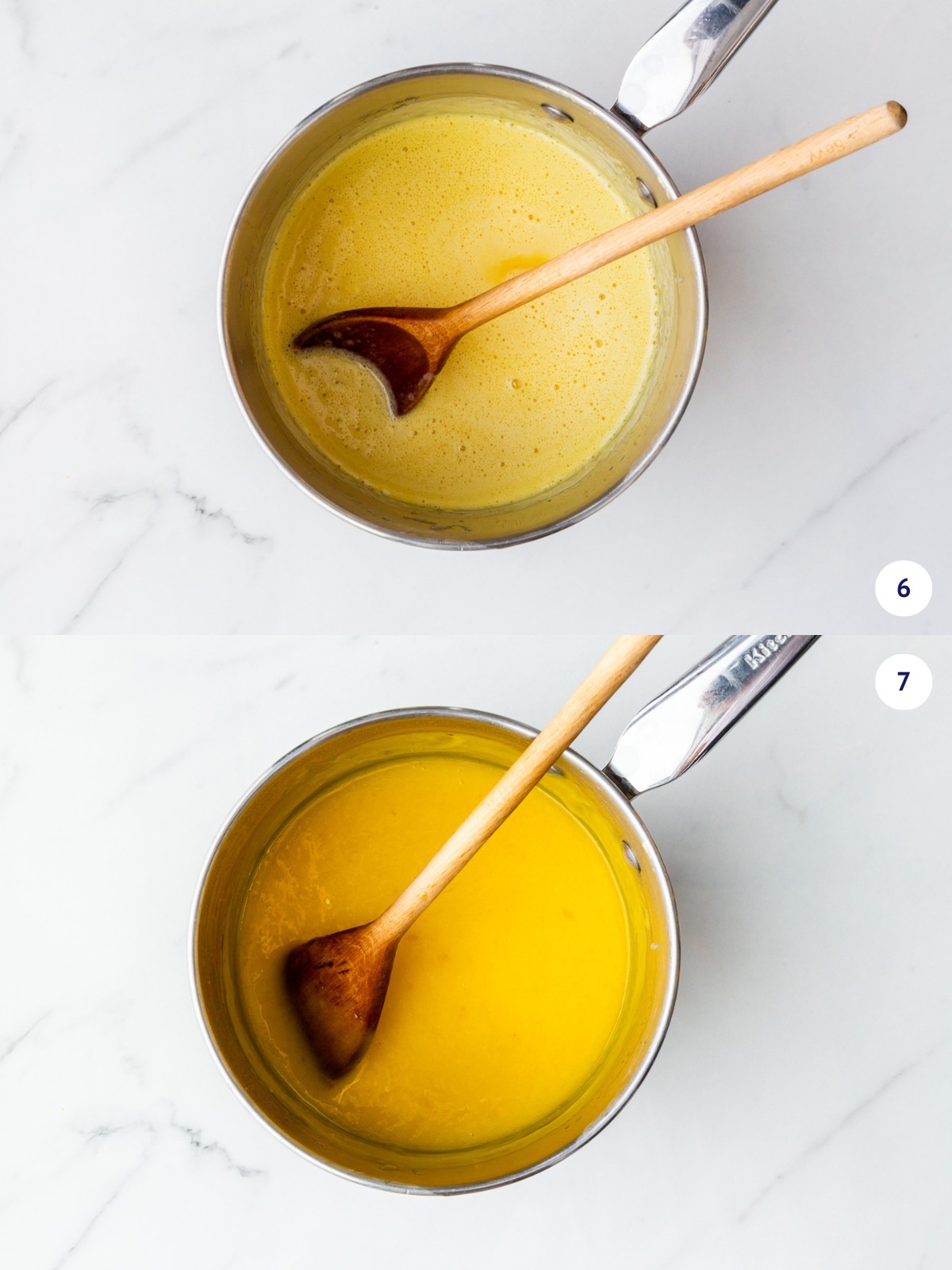
Step 3—Transfer the lemon curd mixture back to the saucepan (image 6) and heat it on low until it almost comes to a boil. You will notice that when the lemon curd is done cooking, it coats the back of a wooden spoon, is glossy and bright, and the foam has completely disappeared (image 7).
Note: Though I like to check on the texture with a wooden spoon, I prefer to use a whisk when I cook lemon curd to ensure that the curd doesn't catch on the bottom and scorch or burn. It's more likely to happen if you stir it with a spoon directly on the stove.
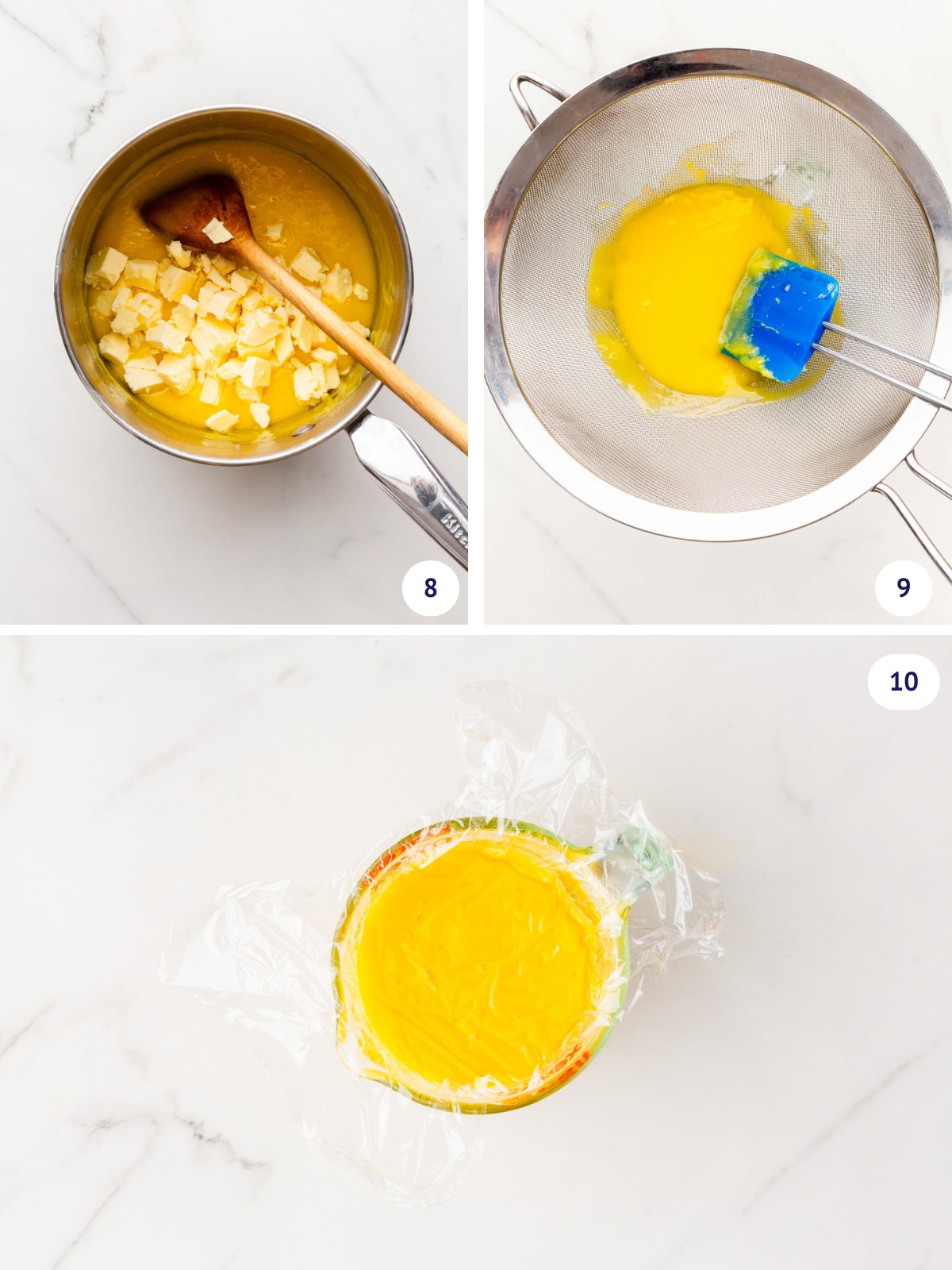
Step 4—Add the butter to the lemon curd (image 8) and stir it in (either with a whisk or a wooden spoon). It should melt in completely and disappear. The goal is not to incorporate air at this stage so don't whip it excessively. Pour the lemon curd through a strainer set over a large measuring cup (image 9) and strain it to remove any bits of cooked egg yolk or lemon pulp/zest. Cover with plastic wrap applied directly to the surface of the curd (image 10).
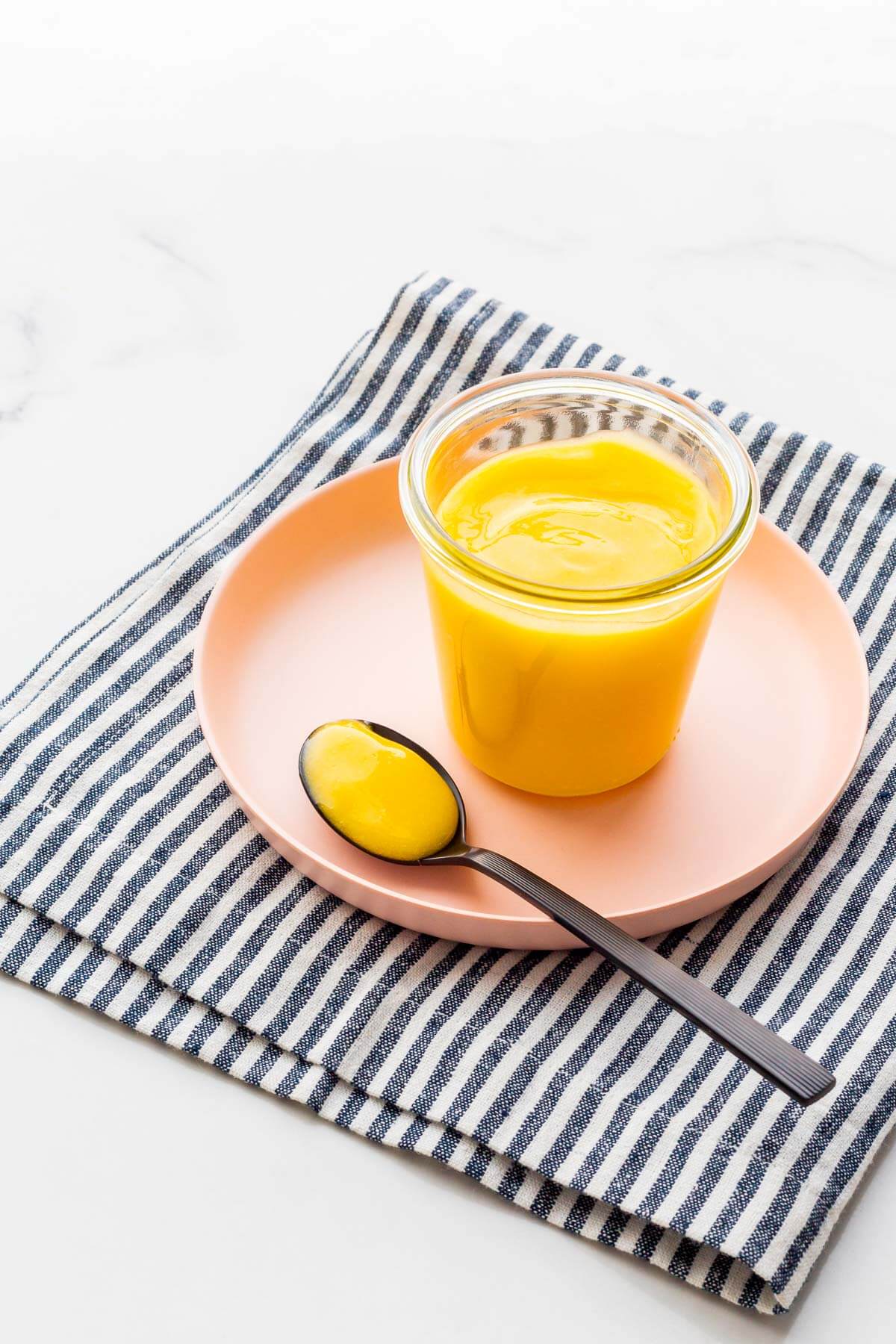
Top Tip: Lemon Curd Setting Temperature
Fruit curds have to be heated to above a certain temperature to set properly, just like marmalade has a setting temperature. This is especially important if you want to use lemon curd to fill cakes, tarts, and bars.
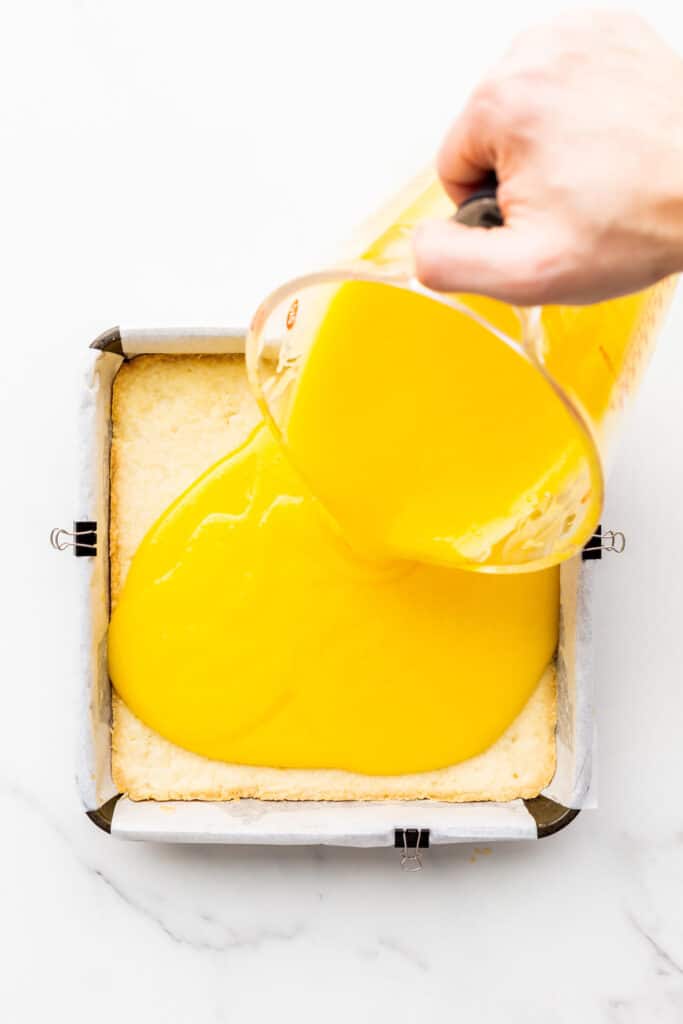
For example, these easy lemon bars are made from a 1-2-3 shortbread cookie crust topped with lemon curd, which was cooked on the stove. To be able to cut these bars, the lemon curd has to be cooked, almost to the boiling point, so between 77ºC and 93 ºC (170 ºF to 200 ºF). You can go higher (and even boil it), but there is more risk of hard-cooked bits of egg in your curd, ruining the texture.
Lemon Curd Variations and Spinoffs
You can take this base recipe and adapt it to make passion fruit curd (which I used to make passion fruit matcha tarts) or even grapefruit curd (which I used to make coconut sandwich cookies). The same principle behind this recipe is used to make a blackberry curd that is stabilized with gelatin to fill this Milk Bar-style blackberry almond layer cake.
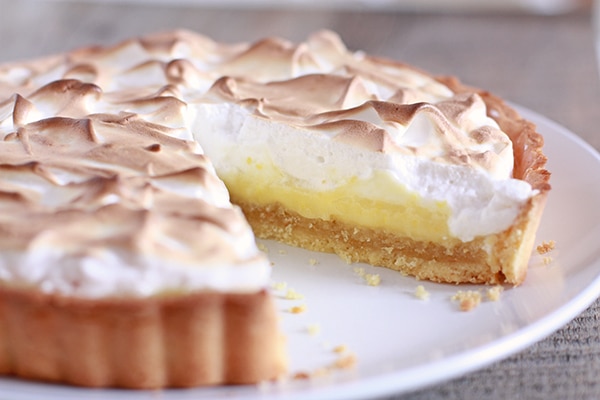
Once you've mastered making lemon curd, you can take this technique and use it to make these easy lemon bars. You can also fold lemon curd into whipped cream to make lemon mousse. Lemon curd makes a great topping for cakes:
- you can spoon it over a pavlova with whipped cream and fresh berries.
- top a gluten-free lemon cake with a thick layer of lemon curd and fresh raspberries for another show-stopping dessert!
- I love to serve gingerbread cake with lemon curd
Fruit Curd FAQs
Lemon curd becomes quite thick when it's cold, thick enough that it can be used as a tart filling and the tart can be sliced cleanly. This is partly due to the eggs, but also because the butter will solidify when cold. If your lemon curd is runny, it could be because you haven't chilled it sufficiently. I prefer to chill lemon curd in the fridge overnight to make sure it sets properly before I use it, especially when using it as a filling for cakes.
It could also be too soft or runny because you didn't cook the curd to a high enough temperature. The cooked curd should be very thick, like pudding when properly cooked, and coat the back of the spoon. The curd should cook to above 77 ºC or 170 ºF.
Some lemon curd recipes are made with whole eggs, but I prefer lemon curd made with egg yolks. Egg yolks make a brighter yellow curd that is less opaque and hazy looking. I also think the flavour is richer using egg yolks.
Egg white proteins coagulate at a lower temperature than egg yolks, and I find that it's very important to strain curds made with whole eggs because of the whites, which form little lumps.
If you notice clumps or lumps in your lemon curd, it could be that you overcooked the curd and the eggs coagulated and cooked "hard." You can strain the curd to remove the lumps.
If you used lemon zest to make lemon curd, the zest will lead to a less smooth mouthfeel. I recommend straining it.
If you made lemon curd with starch or flour, if you didn't incorporate it properly using a whisk, these could form lumps where the clumps hydrate and gel on the surface but stay dry in the middle.
If you set the curd with gelatin, it's important to whisk the gelatin into the curd when the curd is warm, otherwise, you may end up with beads of unmelted gelatin in the curd.
I make my lemon curd directly on the stove, but if you struggle with your curd over-cooking, try using a water bath/double boiler set up. Whisk all the ingredients together in a bowl and place the bowl over a water bath with 1–2 inches of simmering water. Heat the lemon curd gently until it thickens and heats to above 82 ºC or 180 ºF. For this method, the butter may be added at the beginning or at the end. Personally I always like to finish with the butter at the end, whisking it into the hot curd, which helps cool it down once you've hit the right temperature for set.
Lemon curd is used as a filling or a spread. Traditionally, it's served with scones for afternoon tea. You can also spread it on toast for breakfast.
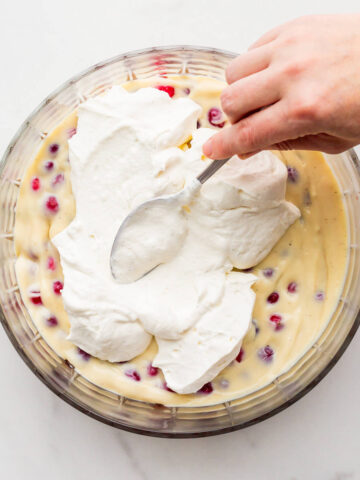
You can fold lemon curd into whipped cream to make lemon mousse or layer it with whipped cream to make an apricot trifle.
You can also sandwich it between layers of sponge cake, like this warm milk sponge cake or between layers of vanilla cake with chocolate frosting.
If you tried this recipe for the best lemon curd (or any other recipe on my website), please leave a ⭐ star rating and let me know how it went in the comments below. I love hearing from you!
📖 Recipe
Lemon Curd
Ingredients
- 170 mL fresh lemon juice
- 200 grams granulated sugar
- 8 large egg yolk(s)
- 150 grams unsalted butter cut into pieces
Instructions
- In a medium saucepan, combine the lemon juice with half the granulated sugar. Set on a burner on medium–high heat.
- Meanwhile in a medium heatproof bowl, whisk together the egg yolks with the rest of the sugar. Whisk vigorously until the mixture turns a very pale, light yellow. Set aside.
- Place another bowl with a strainer over top next to the stove, and have the chopped butter ready on a plate close by as well. Have a heatproof spatula ready too. Do all this before going any further.
- When the lemon juice just comes to a boil, take the pot off the burner and pour the juice over the sugary egg mixture. Whisk to temper the eggs and combine all the ingredients together. Pour the mixture back into the saucepan and return the pot back onto the burner. Whisk the mixture over medium–low heat until it is thick enough to coat the back of a spoon and clings to it. You can use a thermometer to monitor the temperature: a properly cooked lemon curd is cooked to 77ºC and 93 ºC (170 ºF to 200 ºF).
- After the curd has reached the right set and temperature, immediately take the pot off the burner and turn it off. Drop the butter into the saucepan, whisking constantly.
- When all the butter has melted into the curd and disappeared, transfer it to the strainer set over a bowl. Collect the curd in the bowl, then cover with cling film pressed directly on the surface to protect it from the air. Chill overnight.
Notes
- For the brightest, best flavour, please use freshly squeezed lemon juice from fresh lemons
- Do not substitute the lemon juice sold in bottles at the grocery store! It won't yield the same flavour or colour.
- You can also add lemon zest along with the juice. Make sure to strain the curd to remove the bits of zest which will ruin the smooth texture of the curd otherwise.
- For a thicker lemon curd, I have brought it up to a boil, but there is more risk of lumps of cooked egg.
- Beware of the material of your bakeware and cookware. Use high-quality stainless steel to avoid imparting a metallic flavour to your curd.
- Calories calculated per teaspoon of curd.
Nutrition

Leave a Reply